Have you noticed how casually the fashion world throws around the words “plus size” as if they were neutral and harmless? On paper, it sounds like a technical term. In real life, it often feels like a giant neon sign saying: “You are outside the norm.”
For many plus size women in midlife, especially if we wear a UK 14, 16, 18 or above, this label can land like a slap. When did a body that looks like more than half of the women you see in Tesco suddenly become “plus”? And plus what, exactly – plus unworthy, plus invisible, plus difficult?
If you’re new here and navigating midlife changes, you might also like my Menopause Guide, where I pull together the basics about hormones, symptoms and how they can affect things like weight and body image.
Who invented “plus size” anyway?
The history of the term “plus size”
The label didn’t drop from the sky; it came out of the fashion industry trying to organise and sell clothes in a mass‑market world. When ready‑to‑wear clothing took off in the early 1900s, brands needed words for different body types – and surprise, surprise, they didn’t choose neutral language.
One of the first big US retailers to target larger women was Lane Bryant. In the early 1900s they created garments for “Expectant Mothers and Newborns,” then started a category called “For the Stout Woman,” with bust sizes from 38 to 56 inches. That word “stout” sounds dated now, but it tells you everything about how larger women were viewed: not as normal customers, but as a special, separate problem to solve.
By the 1920s, Lane Bryant began advertising “Misses’ plus sizes,” offering sizes 16–30 and recognising that standard patterns simply didn’t fit a lot of women. Within a few years, they dropped the word “misses” and kept the term we still live with today: plus‑size.
Here’s the crucial bit: the term originally referred to clothes, not people. It described extended sizing ranges, not some moral category of womanhood. But by the 1950s, brands were already talking about “plus‑sized women” in their ads, quietly shifting the language from garments to bodies. Once again, the body becomes the issue, not the limited product.
So no, you’re not imagining it: this label was never really neutral. It was commercially convenient, and it carried judgment from the beginning.
Who decided what counts as “normal” or “plus size”?
What size is “average” for women today?
Let’s talk about that word that sits silently next to “plus”: normal.
If we say “plus size,” we are quietly saying that everything up to that point is the standard, the reference point, the default. Above that? You’re extra. You’re an exception. You’re lucky if we bother to design for you.
What’s wild is that the “default” size in fashion is often nowhere near the average woman’s body. Data from style app Mys Tyler suggests that in the UK, the average woman wears between a size 16 and 18. Their figures show that around 62% of women in the UK wear a size 16 or above, and almost half are considered “plus‑size” at size 18+.
So let’s spell that out: almost half of British women wear sizes that the industry labels as “plus.” That isn’t a niche. That isn’t an edge case. That’s a huge chunk of the population. Why are we calling the statistical norm “plus”?
International data tells a similar story. Estimates put the average woman in the UK at around a size 16, equivalent to a US 16 or EU 44. The US average is also around a 16–18. Yet the samples you see on runways and campaigns are far smaller: one report found only about 2.4% of looks at London Fashion Week AW24 were “plus‑size,” even though nearly half of women fall into that category.
In other words, “normal” in fashion has been defined by sample sizes, patriarchy, and a very narrow beauty ideal – not by real women’s bodies.
What this looks like for me as a “plus size” woman
No surprise here: I’m a UK size 16/18 these days. Before the big “M”, menopause, I was always a UK 12. The reason for this article is that I am really fed up with labels attached to plus size women in midlife. I am not “plus size” or whatever else they want to call me. I already have enough on my plate trying to navigate what Mother Nature has given us, women, as a “Greek present” in midlife, the menopause.
I get so disappointed when I like a piece of clothing, only to find it stops at UK 14 / EU L. S
Fashion industry, just stop and look around. It’s not because we’re over 50 that we suddenly want to dress like our grandmothers used to (sorry, no offence to grandmas). I love fashion and I want the same cool trousers, dresses and jeans that women in a UK 12 are wearing.
I think that menopause and being overweight are punishment enough, don’t you?
Men get “big and tall” and women get “plus size”
There is a men’s equivalent of extended sizing, but it’s framed differently. Retailers have long used “Big and Tall” to describe larger menswear, and there’s a whole “big and tall” segment in the market. But that language doesn’t carry the same shame and side‑eye that “plus size” does for women. “Big and tall” can even sound a bit aspirational – tall, strong, solid – while “plus size” for women is often treated as a problem to be fixed.
You rarely hear a man described socially as “plus‑size.” Women, on the other hand, get this label attached to our bodies, our dating lives, our health, even our worth.
That difference isn’t accidental. It reflects a culture that is much harsher on women’s appearance, and especially on women’s weight.
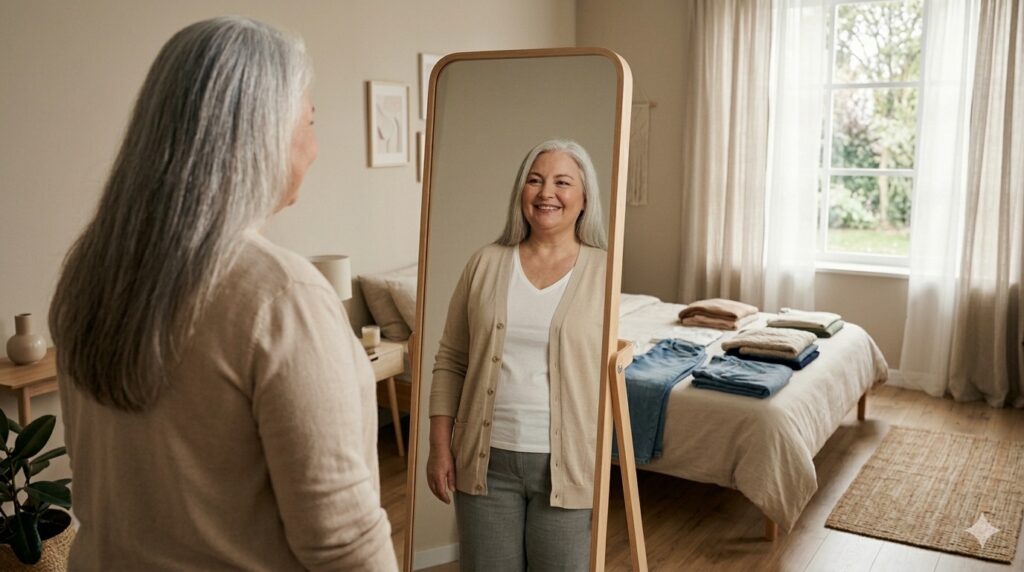
The patriarchal boxes we’re squeezed into
For women in midlife, this hits particularly hard. We’re already navigating menopause, hormonal changes, shifts in metabolism, and a body that may not respond to food and exercise the way it did when we were 25. And just as we’re getting wiser and more grounded, the culture still tries to shrink us – literally and figuratively.
The problem is not that brands offer different fits – that’s practical and helpful. The problem is the way those categories become hierarchies: regular sizes, “petite” (small but acceptable), “plus” (too much, but we’ll make a section for you at the back, next to the lifts and the fluorescent lighting).
When you’re a midlife woman, maybe a UK 14, 16, 18, looking for a dress that fits your actual life – work, teenage kids, ageing parents, hot flushes – being sent to a separate “plus size” corner can feel like being told, yet again: you don’t belong in the main story.
And yet, statistically, we are the story. Our bodies are closer to the average than the size 8 mannequin ever was. The label doesn’t describe reality; it enforces a fantasy.
Brands can limit sizes – but they don’t get to label us
Here’s an important distinction:
Brands absolutely can decide what size range they design for. That’s their business model. What they don’t need to do is label the women outside their range as “plus.”
If a brand stops at a UK 14, what they’re really saying is: “We don’t design for the average British woman.” That’s their limitation, not yours. Yet the way the language is used, it’s the woman in the size 18 jeans who’s called “plus size,” not the brand who’s called “minus inclusive.”
Imagine flipping it: Instead of “plus‑size women,” we talk about “limited‑range brands” . Instead of women apologising for needing a size 16 or 18, brands have to explain why they refuse to stock the sizes most women actually wear.
Some retailers are starting to get this. There have been attempts at “all‑inclusive” size ranges where the same styles are available across many sizes, instead of shunting larger sizes into a separate mini‑collection with completely different designs. Even when these initiatives stumble, they prove the point: people want clothes, not stigma.
Your body is not “plus.” Your body is the customer. If a label doesn’t fit, that’s the product’s fault, not yours.
Why the “plus size” label stings more at midlife
For Silverlocks readers – plus size women of 45, 50, 60 and beyond – this is not just about shopping. It’s about identity, and how we choose to live the second half of our lives.
Midlife often comes with weight redistribution around the middle thanks to hormonal changes. Bloating, water retention, or changing bust size. There are different priorities now – comfort, quality – over squeezing into something tiny for the sake of it.
At the same time, we carry decades of messages about “watching our figure,” “not letting ourselves go,” and “looking youthful.” The “plus size” label taps into that old conditioning and tries to keep us obedient and apologetic.
But many of us are simply done.
We’re done apologising for existing in a body that has carried pregnancies, traumas, careers, relationships, losses, and joys. We’re done rewarding brands that pretend the average woman is still a size 8. We’re done believing that being “plus” anything makes us lesser.
If anything, at midlife we are plus experience, plus wisdom, plus boundaries, plus “no thank you” to nonsense. The only thing we’re not plus is patience for labels that shrink us.
To other midlife women
If you’ve ever stood in a fitting room, tugging at a zip and thinking, “So this is it, I’m officially plus size now,” I want to say this clearly:
You are not a label. You are not a category in a buyer’s spreadsheet. You are not a problem for pattern cutters to solve.
You are a whole, complex, midlife woman with a lot more on your CV than a dress size.
And if you feel angry at the unfairness of it all, that’s not you being over‑sensitive. That’s you, like so many plus size women in midlife, recognising a system built on patriarchal beauty standards and deciding you’d rather opt out.
At this stage of life, we don’t need to be smaller to take up space. We need to be louder, kinder to ourselves, and more demanding of the industries that want our money while disrespecting our bodies.
So no, you are not “plus size.”
You are just your size.
And that is more than enough.
Disclaimer – This is a personal reflection on body image and fashion language, not medical or therapeutic advice. Bodies and experiences are diverse; if you’re worried about your health, please talk to a qualified professional you trust.