
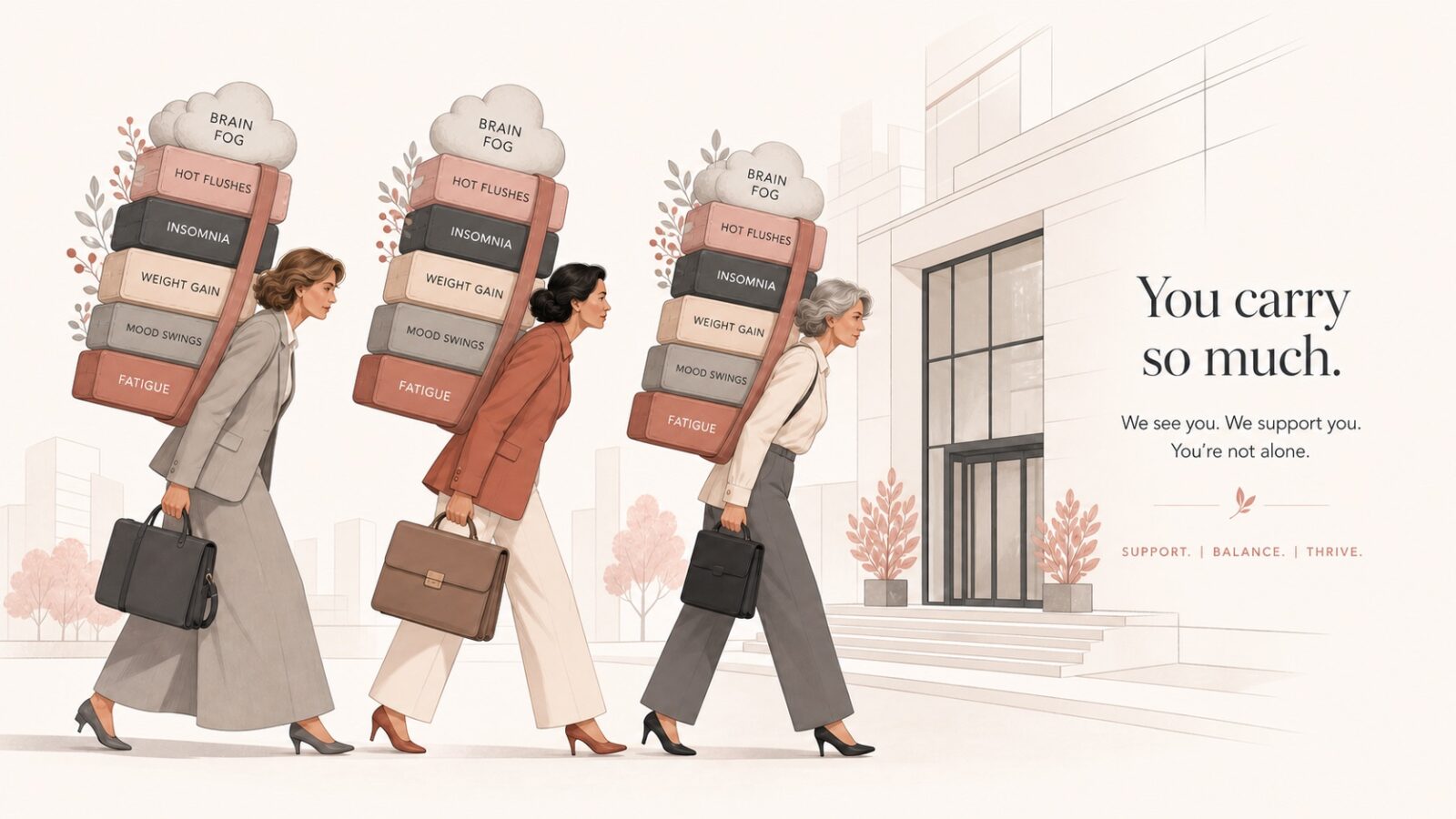
There’s a moment that many women in their 40s and 50s know all too well. You’re sitting in a meeting, suddenly drenched in sweat, struggling to find the word that was right there a second ago. Your heart is pounding. You’re exhausted from another night of broken sleep. And the last thing on earth you want to do is explain to your manager — or your colleagues — what’s actually going on. If any of this sounds familiar, you’re far from alone — and it’s exactly why companies should talk about menopause far more openly than most currently do.
For decades, that silence was considered professional. Polite, even. You just got on with it. But that silence has a cost — for women, for companies, and for the economy as a whole.
And increasingly, forward-thinking organisations are realising that talking about menopause isn’t uncomfortable. Not talking about it is what’s truly costly.
Why Companies Should Talk About Menopause: The Scale of the Issue Is Bigger Than You Think
Right now, there are an estimated 13 million women in the UK navigating perimenopause or menopause — that’s 1 in 3 of the total female workforce. The average age of menopause in the UK is 51, but perimenopause — the hormonal transition phase with the most disruptive symptoms — can begin as early as the early 40s. That means the women most affected are often the same women who’ve spent 20-plus years building expertise and holding senior positions.
According to the CIPD (Chartered Institute of Personnel and Development)
73% of women aged 40–60 who are currently employed have experienced symptoms related to menopause transition.
Two-thirds of those say the symptoms have had a mostly negative effect on their work. Over half — 53% — have had to take time off work at some point because of their symptoms.
That is not a small minority. That is a significant proportion of the experienced female workforce, quietly struggling — and often leaving.
The Talent Drain Nobody’s Talking About
Here’s what makes this a genuine business crisis rather than just a health issue: 1 in 10 women who work during menopause leave their jobs because of their symptoms. Not because they’ve lost interest. Not because they lack ambition. But because their workplace has failed to offer them the most basic understanding or support.
Women aged 45–55 are, on average, at the peak of their professional capability — occupying senior roles, managing large teams, holding institutional knowledge that took decades to build. Losing this cohort doesn’t just affect individual women’s careers; it actively hollows out organisations and widens the gender pay gap.
The CIPD found that 27% of women say menopause has had a negative impact on their career progression. And for women with a disability or long-term health condition alongside menopause, that figure jumps to 36%. When we factor in the intersectional data — that 38% of ethnic minority women report menopause has quite or very negatively impacted their career progression — it becomes clear this is also very much a diversity and inclusion issue.
Meanwhile, the CIPD also found that only 24% of organisations have a menopause policy or other support measures in place, and more recent research from Brightmine puts that figure at just 45% even among larger employers — with only 3% making their policy publicly available. A separate 2026 survey found as few as 18% of UK workplaces had a menopause policy at all.
The gap between the need and the provision is enormous.
What This Costs Companies (and the Economy)
The UK Parliament’s own report on menopause in the workplace identified 14 million working days lost each year due to menopause, a figure that equates to approximately £1.88 billion in lost productivity. Research from Peppy Health extends this further: when perimenopause is factored in alongside menopause, the total economic cost could be as high as £2.9 billion per year — the equivalent of 22 million lost working days.
Research published by Entrepreneur UK puts the figure at £1.7 billion annually in lost productivity, lost working days, and menopause-driven unemployment. Meanwhile, the balance menopause app calculated that the lack of awareness and support could be costing the UK economy close to £10 billion, once recruitment and retraining costs are factored in.
The government’s own literature review, published in 2025, estimates an annual cost of approximately £1.5 billion due to unemployment caused by menopause, plus a further £191 million due to absenteeism.
Whichever figure you use, the message is the same: this is not a “soft” issue. It has a very real bottom-line impact.
And for individual employers? Replacing a senior female employee costs between 50% and 200% of her annual salary, depending on the sector. For a role paying £60,000, that’s potentially between £30,000 and £120,000 in recruitment, retraining, and lost productivity — for one person, one departure. When you’re losing employees from an identifiable, addressable cause, and you haven’t addressed it, that becomes a strategic oversight.
The Legal Picture Is Changing
Beyond the human and financial case, there’s an increasingly important legal dimension that companies cannot afford to ignore.
While menopause is not (yet) a standalone protected characteristic under the Equality Act 2010, it is covered by three existing protected characteristics: age, sex, and disability. Employers who dismiss, demote, or fail to support an employee because of their menopausal symptoms are at real risk of discrimination claims.
And those claims are happening.
Menopause-related employment tribunal cases more than tripled between 2022 and 2024,
rising from 64 to 204 reported cases in a single year. Employers are losing them — sometimes at significant financial cost. In one notable case, a claimant won £18,000 in compensation after her manager’s demeaning comments about her menopausal status created a hostile work environment.
The regulatory direction is clear. Under the Employment Rights Act 2025, employers with 250 or more workers are now required to produce equality action plans — which must include actions to support employees experiencing menopause. These plans are currently voluntary but will become mandatory from April 2027. Companies that haven’t started thinking about this will face a very tight window.
The CIPD puts it plainly: organisations have a legal obligation to conduct health and safety risk assessments that consider the specific needs of those experiencing menopause — looking at temperature, uniforms, toilet access, rest facilities, and more.
Why Companies Should Talk About Menopause: The Conversation Itself Is the First Step
It’s tempting to think that “supporting employees through menopause” requires a big budget, a new HR department, or an elaborate policy document. It doesn’t. The most powerful first step is also the simplest: just start talking about it.
Approximately 94% of women believe that society should be more open about discussing menopause.
When workplaces normalise that conversation — when a manager knows enough to have a kind, informed check-in with a team member — the difference it makes is enormous.
Research consistently shows that the gap between supported and unsupported employees is stark. The CIPD found that 84% of women who are unsupported say menopause symptoms have a mostly negative effect at work, compared with 71% of those who feel supported. That gap is the direct result of whether a conversation happened — or didn’t.
There’s also evidence that manager training makes a significant difference. A government-cited study found that 90% of managers who received menopause training reported improvements in their knowledge and confidence. Equipping managers to have sensitive, informed conversations with their teams is one of the most cost-effective interventions an employer can make.
What Good Menopause Support Actually Looks Like
Companies leading the way on this aren’t all spending large amounts of money. Many of the most effective adjustments are low-cost and high-impact. Here’s what the research and best practice suggest:
- Flexible working: Allowing women to manage their hours around unpredictable symptoms — starting later after a sleepless night, working from home on difficult days — is consistently rated as one of the most valued forms of support. The CIPD found that 67% of women believe the shift to hybrid working makes managing menopause symptoms easier.
- Temperature control: Access to a desk fan, a cooler workspace, or simply the ability to open a window. This costs almost nothing and can make a profound difference to someone managing hot flushes throughout the day.
- Menopause-aware management: Training line managers to understand what menopause is, what symptoms look like, and how to have supportive — not intrusive — conversations. Acas provides this training in the UK, along with free webinars.
- A formal menopause policy: A written policy signals to all employees that menopause is taken seriously. It sets expectations, outlines available support, and establishes a point of contact — whether that’s HR, a menopause champion, or an occupational health team.
- Absence management that reflects reality: Recording menopause-related absence separately from other sickness absence so that it is not unfairly counted against an employee’s overall attendance record. This is both good practice and increasingly a legal obligation.
Some companies are going further. Bupa offers employees free access to a GP-led Menopause Plan plus a 24/7 menopause phoneline. Boots covers the cost of employees’ HRT prescriptions. Travis Perkins has created an internal community called the “hot flush community” where employees can share experiences and ask questions. These aren’t gimmicks — they’re practical signals that the company values the people working for it.

Why This Is Also a Leadership Pipeline Issue
Here’s a perspective that often gets missed in the menopause at work conversation: we’re not just talking about employee wellbeing. We’re talking about leadership continuity.
Women experiencing perimenopause are, statistically, at the height of their career. When they leave because of unmanaged symptoms, they take with them not just their current skills, but decades of institutional knowledge, client relationships, and organisational memory.
Furthermore, research from Entrepreneur UK notes that the median age of UK business founders is 38–40, with 35% of UK businesses started by people over 50. This means many entrepreneurial women are navigating perimenopause precisely at the moment they have the experience and the resources to build something lasting. When those women are let down by their employers — or pushed out — the wider economy loses not only workers but potential founders and innovators.
The Culture Shift Is Already Happening
The good news is that attitudes are changing — and quickly. Over the last few years, menopause has moved from being almost entirely taboo in professional settings to being the subject of government reports, parliamentary hearings, media campaigns, and increasingly mainstream workplace policy.
Five years ago, the first UK workplace menopause policy was launched by Channel 4. Since then, awareness has grown significantly — though, as the Women in Work Workplace Menopause Progress Report 2025 benchmarked across 400 of the UK’s largest companies reveals, there is still a long way to go.
The shift is important: when companies talk openly about menopause, they signal to every employee — not just those experiencing symptoms — that health matters here, that conversations about wellbeing are safe, and that the organisation values people at every stage of their working lives. That kind of cultural signal has a reach far beyond any one policy document.
There is a growing body of evidence that workplaces which openly support employees through menopause see real returns: reduced absenteeism and burnout, higher productivity, and better retention of experienced women in senior roles.
This Isn’t Just “A Women’s Issue”
One final, important point: menopause in the workplace is not just something women need to sort out among themselves.
When a woman is struggling with symptoms that affect her concentration, sleep, and confidence, and her manager doesn’t know what to say, and HR has no policy, and her colleagues snigger — that is an organisational failure, not a personal one.
It’s an issue for managers, HR teams, CEOs, and board members. It’s an issue for men who manage women, partner with women, work alongside women. It’s an issue for younger colleagues who will one day inherit the workplace culture being created right now.
It’s an issue that, handled well, benefits everyone. A workplace where it’s safe to talk about health, where flexibility is built into working practices, where people are trusted to manage their own needs — that’s a better workplace for everybody.
The conversation about menopause doesn’t end the moment the policy is written or the training is delivered. It’s ongoing. But it has to start somewhere. And for many companies, that starting point is right now.
Want to find out more about menopause and the workplace? Visit Acas: Supporting Workers Through Menopause for practical guidance for employers, or explore the CIPD’s full report on Menopause in the Workplace for in-depth data on employee experiences and what makes the biggest difference.
References
- CIPD: Menopause in the Workplace – Employee Experiences 2023
- Acas: Supporting Workers Through Menopause
- Acas: Menopause and the Law
- CIPD: Menopause – UK Employment Law
- Peppy Health: The Hidden Costs of Menopause
- Entrepreneur UK: The UK’s £1.7bn Perimenopause Problem
- REBA: Why We Need to Talk About Menopause at Work
- Brightmine: UK Employers Lag on Menopause Policies (2025)
- Gov.UK: Shattering the Silence About Menopause – 12-Month Progress Report
- Menopause in the Workplace: Legal Considerations and Case Studies
- Women in Work Workplace Menopause Progress Report 2025
- Femtech World: Only 18% of UK Workplaces Have a Menopause Policy (2026)
The information in this article is intended for general informational purposes only and does not constitute medical, legal, or HR advice. While every effort has been made to ensure the accuracy of the statistics and information provided at the time of publication, workplace legislation and research in this area are evolving rapidly. If you are an employer seeking to implement a menopause policy, please consult a qualified HR professional or employment law specialist. If you are experiencing symptoms related to perimenopause or menopause, please speak with your GP or a qualified healthcare provider.