
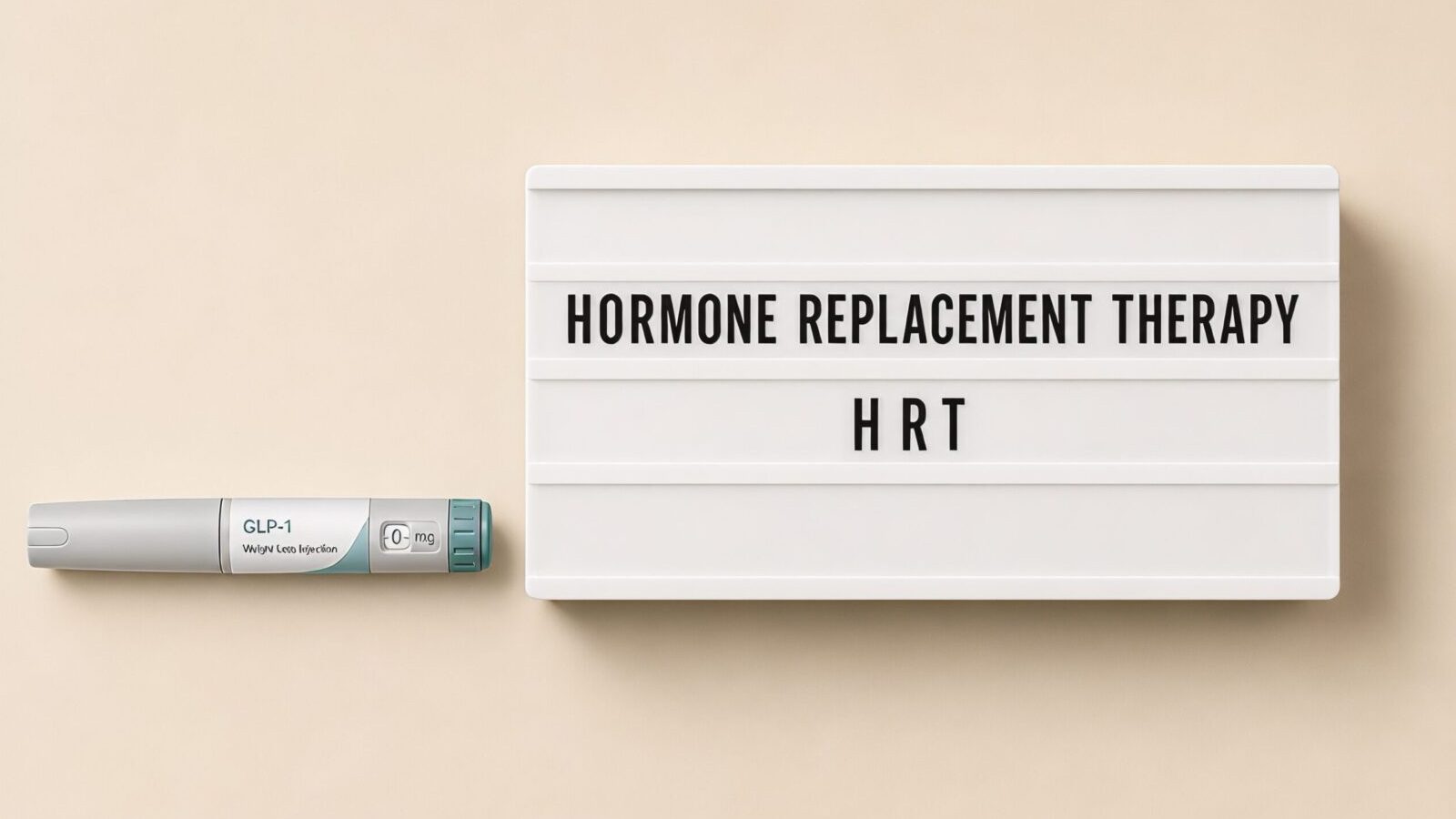
If you have been wondering, Can You Take HRT with Weight Loss Injections, the reassuring answer is that many women can use both together safely, but the type of HRT matters and it is important to review it with a GP or menopause specialist.
If you want to understand weight loss injections in more detail – how they work, who they’re for and the pros and cons – check out our guide to weight loss injections to read more about the subject. And if you’re looking for a fuller overview of symptoms, treatment options and lifestyle strategies, our menopause guide is a great place to start for evidence‑based, midlife‑friendly information.
As more midlife women turn to medications such as Wegovy, Ozempic and Mounjaro to help with weight loss, this question is coming up more and more often. It is a sensible one too, because many women in perimenopause and menopause are already using hormone replacement therapy to manage symptoms such as hot flushes, poor sleep, anxiety, brain fog and vaginal dryness.
The good news is that HRT and weight loss injections are not automatically a bad mix. In fact, for some women, the combination may make a lot of sense.
But there is one important catch: some weight loss injections can affect how your body absorbs oral hormones, especially oral progesterone, which is the part of HRT that helps protect the womb lining if you still have a uterus.
That means the conversation is not simply about whether you can take HRT with weight loss injections. It is really about which form of HRT you are taking, whether it needs adjusting, and what symptoms or warning signs you should watch for once you start a GLP-1 medication.
In this article, we will walk through what current UK guidance says, why the route of HRT matters, which combinations are usually preferred, and when you should go back to your clinician for a review.
Can You Take HRT with Weight Loss Injections?
Yes, in most cases, you can take HRT with weight loss injections. Current UK menopause guidance and NHS prescribing advice do not say women need to stop HRT just because they start a GLP-1 or similar weight loss medication. However, they do advise that women using oral HRT, particularly oral progesterone, should have their treatment reviewed because these injections may reduce absorption of hormones taken by mouth.
So, if you are asking, Can You Take HRT with Weight Loss Injections?, the more complete answer is this: yes, often you can, but non-oral HRT such as patches, gels, sprays, a Mirena coil or combined patches may be the better option for many women.
This matters most for women who still have a uterus and need progesterone for endometrial protection. If progesterone is not absorbed properly, the womb lining may not be protected as well as it should be, which could increase the chance of unscheduled bleeding and may need further investigation.
What are weight loss injections?
When people talk about weight loss injections, they are usually referring to medications in the GLP-1 family or related incretin-based therapies. These include semaglutide, sold under brand names such as Wegovy and Ozempic, and tirzepatide, sold as Mounjaro.
These medicines work in several ways. They help reduce appetite, can improve blood sugar control, and slow gastric emptying, which means food leaves the stomach more slowly. That delayed stomach emptying is one of the reasons they can be effective for weight loss, but it is also why they may interfere with how some oral medicines are absorbed.
That interaction is now getting serious attention in menopause care, because it may affect oral oestrogen and, more importantly, oral progesterone used in HRT.
Why HRT absorption can change on weight loss injections
The main issue is not that weight loss injections clash dangerously with HRT in the way some medications do. The issue is more practical: delayed gastric emptying may reduce or alter the absorption of oral hormones.
According to the British Menopause Society, the primary concern is endometrial protection in women using combined HRT while taking semaglutide or tirzepatide.
In simple terms, if oral progesterone is not absorbed consistently, it may not protect the lining of the womb as effectively as intended.
NHS Lothian guidance makes a similar point. It notes that incretin-based therapies could reduce exposure to oral progestogens used as part of HRT and could therefore compromise the essential endometrial protection the progestogen provides. The same guidance also notes that oral oestrogen exposure could be reduced, potentially causing a return of menopausal symptoms or some unscheduled bleeding, even if this would not usually cause direct clinical harm.
This is why so much of the advice around Can You Take HRT with Weight Loss Injections comes down to one thing: route.
Hormones that bypass the gut are much less likely to be affected.
Which types of HRT are usually best?
For many women, transdermal oestrogen is the simplest and safest choice alongside weight loss injections. That includes patches, gels and sprays. Because these forms are absorbed through the skin rather than through the digestive system, they are not expected to be affected by delayed gastric emptying.
For progesterone, non-oral routes are usually preferred too. This might include:
- A 52 mg levonorgestrel intrauterine system such as Mirena
- A combined HRT patch containing both oestrogen and progestogen
- Vaginal progesterone, where prescribed off licence by a specialist
The British Menopause Society says the Mirena coil is likely to be the most comprehensive option for endometrial protection in women using combined HRT together with semaglutide or tirzepatide. That is because it provides local protection in the uterus and is not affected by gut absorption.
If you are already using a patch or gel with a Mirena coil, you may not need much change at all. But you should still mention your weight loss injection to your GP or menopause clinic so they can review the whole picture.

What if you are on oral HRT?
If you take oral oestrogen or oral progesterone, it does not automatically mean you must stop. But it does mean you should not ignore the issue.
The British Menopause Society advises that if treatment with incretin-based therapies is proposed in a woman using oral oestrogen-based HRT, consideration should be given to switching to transdermal oestrogen. It also says that where oral progesterone is preferred, a pragmatic approach may be to consider changing to a Mirena coil or increasing the dose of progesterone at initiation and for four weeks after any dose increment.
NHS Lothian goes even further in practical terms. It recommends that all HRT users taking an oral progestogen while also using an incretin-based therapy should either switch to an appropriate non-oral progestogen or, if that is not acceptable, increase the oral progestogen dose for the duration of the incretin-based therapy. Importantly, the guidance also makes clear that there is not enough study evidence to know whether the higher oral doses definitely provide adequate endometrial protection.
Signs your HRT may need reviewing
If you start a weight loss injection and your HRT is not working in quite the same way, your body may give you clues. These do not necessarily mean anything serious is happening, but they should not be brushed off either.
Common signs to watch for include:
- Unscheduled bleeding or spotting after being stable on HRT
- The return of hot flushes or night sweats
- Worsening sleep, anxiety or low mood after symptoms had improved
- Vaginal dryness returning
- New pelvic pain, unusual discharge or a change in bleeding pattern
If any of these happen, the answer to Can You Take HRT with Weight Loss Injections is still not necessarily no. It may simply mean your HRT needs adjusting.
UK guidance is very clear that unscheduled bleeding should always be taken seriously and assessed in line with standard HRT bleeding guidance. In women using oral progesterone and a GLP-1, that review should include asking about the possibility of reduced absorption.
Could taking both actually be beneficial?
For some women, yes. Midlife weight gain is often tied up with hormonal changes, changes in insulin sensitivity, sleep disruption, stress and reduced muscle mass. HRT and weight loss injections work in different ways, so they may complement one another.
HRT can help improve menopause symptoms that make weight management harder, such as poor sleep, low mood, low energy and joint discomfort. At the same time, GLP-1 medications can help reduce appetite and support meaningful weight loss in women with obesity or weight-related health issues.
The British Menopause Society also points out that sustained weight loss in women with obesity appears to reduce endometrial risk. So for some women, managing menopause symptoms while also addressing weight and metabolic health may be a very worthwhile combination.
That said, weight loss injections are not a magic solution, and they work best when they are part of a wider plan that includes adequate protein, resistance exercise, daily movement, sleep support and realistic long-term habits.
Contraception and pregnancy: an important extra point
The British Menopause Society explains that tirzepatide can make the combined oral contraceptive pill less effective. Because of this, the drug manufacturer advises women to use a non‑oral contraceptive (such as a coil or implant) or add a barrier method like condoms for four weeks after starting tirzepatide, and again for four weeks after every dose increase.
Weight loss injections are not recommended in pregnancy, and women planning pregnancy should speak to their prescriber about when to stop them.
Practical questions to ask your GP or menopause specialist
If you are taking, or thinking about taking, HRT with weight loss injections, these are sensible questions to raise at your review:
- Is my current HRT route the best one if I am using a GLP-1 injection?
- Would a patch, gel or spray be better than oral oestrogen for me?
- Do I need to switch from oral progesterone to a Mirena coil or combined patch?
- What should I do if I notice bleeding or my symptoms change?
- Do I need different contraception if I am using tirzepatide?
These are not over-the-top questions. They are exactly the kinds of practical details that matter in real life, and they help women advocate for safe, joined-up care.
Frequently asked questions
Can You Take HRT with Weight Loss Injections if you use a patch?
Usually yes. Transdermal HRT, including patches, gels and sprays, is generally preferred because it bypasses the digestive system and is not expected to be affected by delayed gastric emptying.
Can You Take HRT with Weight Loss Injections if you use Utrogestan?
Possibly, but oral progesterone such as Utrogestan may be affected by GLP-1 medications. That is why UK guidance recommends an HRT review and often suggests switching to a non-oral form of progesterone where possible.
Do weight loss injections stop HRT from working?
Not exactly, but they may reduce absorption of oral hormones in some women. This can lead to a return of symptoms or unscheduled bleeding, which is why monitoring matters.
Do I need to stop HRT before starting Mounjaro or Wegovy?
Usually no, but you should tell your GP or menopause specialist that you are starting one of these medications. They may recommend changing your HRT route or reviewing your progesterone plan.
What is the safest HRT option with weight loss injections?
That depends on your medical history, but in general, transdermal oestrogen plus a non-oral progesterone option such as a Mirena coil is often considered a practical and reliable combination.
References
- British Menopause Society: Use of incretin-based therapies in women using hormone replacement therapy (HRT)
- NHS Lothian RefHelp: HRT and incretin-based therapies (GLP-1 and GIP receptor agonists)
- NHS England: Weight management injections
- Specialist Pharmacy Service: Considerations and interactions GLP-1 receptor
Disclaimer – This article is for general information and education only and is not a substitute for personal medical advice, diagnosis or treatment. It does not cover every possible situation, medicine or health condition, and should not be used to make decisions about starting, stopping or changing HRT, weight loss injections or any other medication. Always speak to your GP or menopause specialist about your own health history, symptoms and treatment options before making changes. Never ignore, delay or replace professional medical advice because of something you have read on Silverlocks.