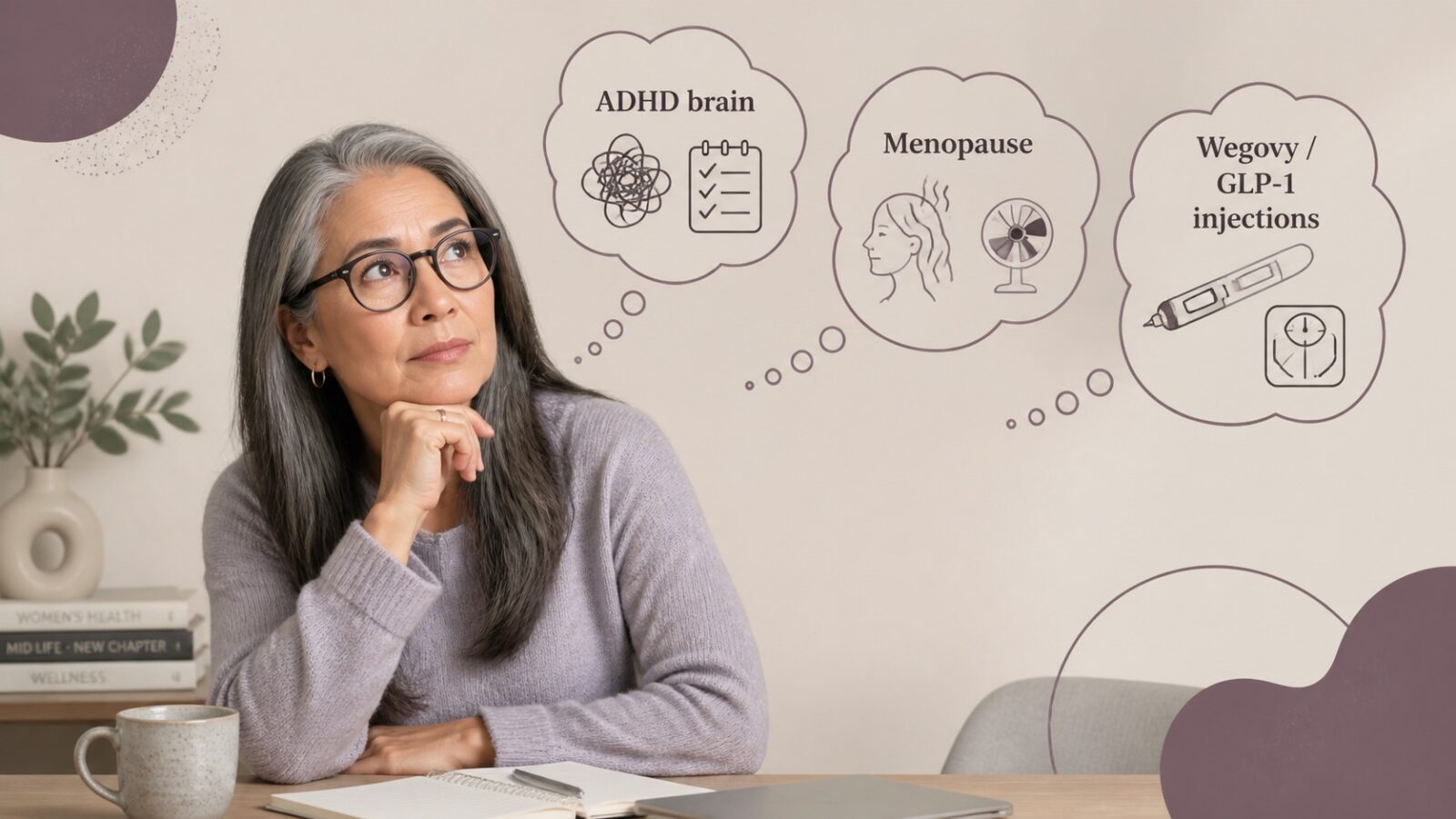
You walked into the kitchen for something. You have no idea what. You snapped at someone you love over absolutely nothing. You’ve been awake since 3am, your brain spinning at full speed, and no amount of willpower seems to slow it down — the classic Wegovy, ADHD and menopause cocktail so many women are now quietly trying to make sense of.
If this sounds familiar — and you happen to have ADHD, or suspect you might — welcome to one of the least talked‑about crossroads in women’s health: neurodivergence and menopause colliding at the same time.
For a deeper dive, you can explore our Menopause Guide for the hormone piece, and our Weight Loss Injections Guide for GLP‑1 treatments and other weight‑loss medications in midlife.
Why Does Menopause Make ADHD So Much Worse?
If your ADHD symptoms have recently gone from manageable to overwhelming, oestrogen is likely part of the explanation.
Here’s something most people don’t realise: oestrogen isn’t just a reproductive hormone. It also regulates dopamine — the neurotransmitter that controls your focus, impulse control, working memory, and emotional regulation. In other words, the very things ADHD already makes difficult.
As oestrogen declines during perimenopause, dopamine signalling becomes increasingly unstable. For women with ADHD, it can feel like losing the scaffolding that was barely holding everything together in the first place.
The numbers are striking. A survey of more than 2,600 women over 46 found that 61% said ADHD had its greatest impact on their daily lives between ages 40 and 59 — not in childhood, not in their 20s. Brain fog, memory problems, emotional overwhelm, and time blindness were all described as “life-altering” during the menopausal transition.
And here’s the part that might make you feel seen: 43% of those women received their very first ADHD diagnosis between ages 41 and 50. For many, perimenopause didn’t worsen ADHD they knew they had — it revealed ADHD that had gone unrecognised for decades.
Research from King’s College London confirmed in 2025 that the worse your ADHD symptoms, the worse your menopausal experience tends to be — including sleep, anxiety, and cognitive function. The two conditions genuinely amplify each other.
So What Is Wegovy, Exactly?
Wegovy is the brand name for semaglutide 2.4 mg — a once-weekly injection approved for weight management in adults with obesity or weight-related health conditions. You may have also heard of Ozempic, which is the same drug at a lower dose, originally developed for type 2 diabetes.
GLP-1 stands for glucagon-like peptide-1, and it’s a hormone your body produces naturally after eating. Wegovy mimics this hormone, signalling to your brain that you’re full, slowing digestion, and reducing appetite.
But — and this is where it gets genuinely interesting — GLP-1 receptors aren’t only found in your gut and pancreas. They’re also distributed throughout your brain, including in areas that govern reward, motivation, and impulse control.
That’s the detail that has researchers and neurodivergent women paying close attention.
The Busy Brain Question: Could Wegovy Actually Quiet the Noise?
Let’s be clear upfront: as of mid-2026, there are zero clinical trials testing Wegovy specifically for ADHD. It is not licensed or approved to treat ADHD, and it shouldn’t be positioned as a replacement for established ADHD treatments.
That said, the biology here is genuinely fascinating — and worth understanding.
It Works on the Same Brain Circuits as ADHD
ADHD is partly characterised by an over-reactive reward system. That relentless sense of wanting — whether it’s food, your phone, the next dopamine hit — is driven by specific circuits in the brain, including the nucleus accumbens.
GLP-1 drugs appear to dampen what scientists call “cue-evoked dopamine signalling” in exactly that region. In plain English: they turn down the volume on the wanting signal. This is thought to be why some women on Wegovy report not just reduced appetite, but also fewer compulsive urges more broadly — less pull towards alcohol, impulsive spending, or the 11pm scroll.
A 2023 study found that semaglutide reduces appetite while simultaneously increasing dopamine signalling in the ventral tegmental area during reward — suggesting a nuanced, not simply suppressive, effect on the brain’s reward circuitry.
The Binge Eating Connection Is the Strongest Evidence
Here’s where the science is most solid, and it’s directly relevant to many women with ADHD.
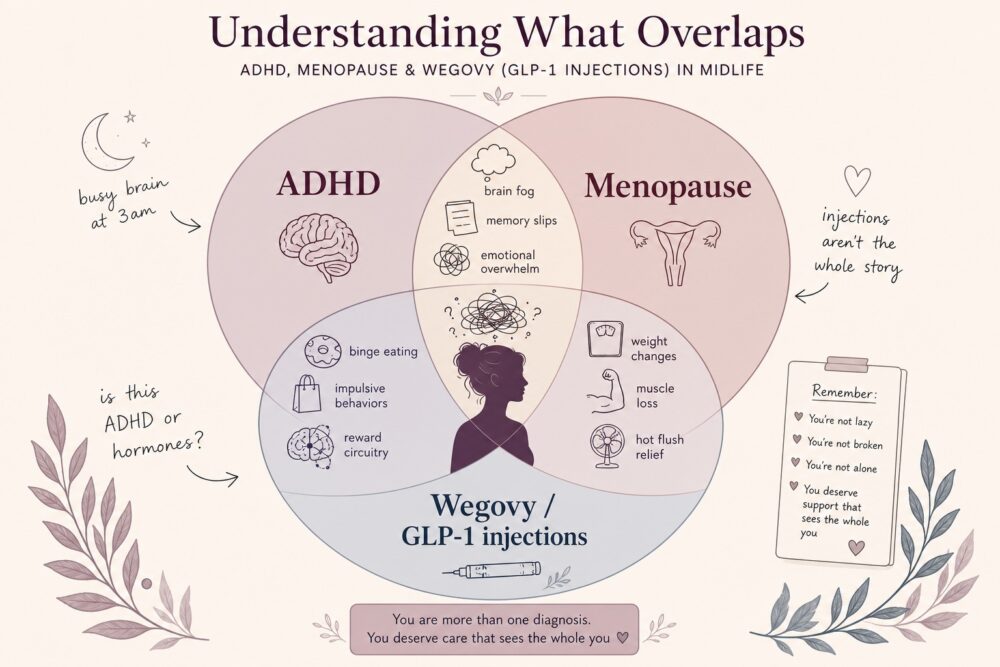
Binge eating disorder (BED) is significantly more common in neurodivergent women than in the general population — and it shares the same impulsive, reward-driven roots as ADHD. Multiple studies now show that semaglutide is genuinely effective at reducing binge eating behaviours.
One study found semaglutide more effective than lisdexamfetamine and topiramate — the two most commonly prescribed medications for BED — at reducing binge episodes. Another found that women on semaglutide showed significantly reduced emotional eating, external eating, and binge frequency. Over 104 weeks, participants showed sustained improvements in their control over eating — including reduced cravings for both sweet and savoury foods.
A 2026 systematic review of 12 studies concluded that GLP-1 receptor agonists offer dual therapeutic benefits for BED: reducing binge behaviours and addressing the comorbid obesity and metabolic consequences.
For women who have spent years battling the exhausting cycle of impulsive eating — not out of weakness, but because of neurodivergent brain wiring — this is meaningful.
But Here’s the Important Catch
The dopamine story isn’t straightforwardly positive for everyone with ADHD, and it’s worth understanding why.
Stimulant medications for ADHD (like methylphenidate or Vyvanse) work by increasing dopamine in the prefrontal cortex. Wegovy dampens phasic dopamine signalling in the reward centres. These are opposing effects on overlapping circuits.
What this means in practice:
- Women whose ADHD is dominated by impulsivity, emotional dysregulation, and compulsive urges may find real relief
- Women whose ADHD is characterised primarily by low motivation, difficulty starting tasks, or emotional flatness may find their symptoms worsen.
Both experiences are biologically plausible. Neither makes you wrong. This is simply why a conversation with your doctor — one who understands both ADHD and menopause — is essential before starting.
The Brain Benefits That Go Beyond the Scales
Even if ADHD isn’t your primary concern, the neurological research on semaglutide has some genuinely exciting implications for menopausal women dealing with brain fog and cognitive changes.
It Fights Neuroinflammation
Menopause increases neuroinflammation — low-grade inflammatory activity in the brain that’s a key driver of brain fog, mood instability, and memory difficulties. And semaglutide, it turns out, is showing real promise as an anti-inflammatory agent in the brain.
Research published in 2026 found that semaglutide reduces neuroinflammatory signalling, suppresses the release of pro-inflammatory cytokines, and modulates the behaviour of microglia — the brain’s immune cells. Animal studies have shown improvements in cognitive performance and memory following semaglutide treatment, with multiple research teams now pursuing human trials.
These are mostly preclinical findings so far, and translating mouse data to human experience requires caution. But the mechanistic case is strong, and researchers are actively investigating.
Wegovy and Menopause: The May 2026 Data
Fresh data presented at the European Congress on Obesity in May 2026 confirmed that Wegovy delivers significant and consistent weight loss across all menopause stages — premenopausal, perimenopausal, and postmenopausal — with an average weight reduction of 22.6% for premenopausal women and comparable results throughout.
The same data showed a 42–45% lower risk of depression and migraine in women taking Wegovy. Both of these are significantly more prevalent in women with ADHD, and both worsen during perimenopause. That’s not a small finding.
Additionally, a 2024 study found that postmenopausal women who combined semaglutide with HRT experienced greater weight loss than those on semaglutide alone — relevant for the many midlife women managing both.
What About Side Effects?
The Physical Ones
The most common side effects are gastrointestinal, and they’re real:
- Nausea — very common, especially during the dose escalation phase; for most women it eases over time
- Diarrhoea, vomiting, and constipation
- Fatigue — worth monitoring closely if you’re already exhausted from disrupted sleep and hormonal changes
- Headaches and dizziness
- Hair thinning — reported by some users; thought to be related to rapid calorie reduction rather than the drug itself
These side effects are significantly more common on Wegovy than on placebo, and they’re the main reason women discontinue treatment.
The Mental Health Picture
This matters especially for neurodivergent women, who carry higher baseline rates of anxiety and depression.
The reassuring news: large observational studies have not found an overall increase in depression or psychiatric problems in people taking Wegovy compared to other weight-loss medications. Following a thorough review, the UK’s MHRA concluded that current evidence does not establish a causal link between GLP-1 medications and suicidal ideation or depression.
However — and this is important — the dopamine-dampening mechanism means that a subset of women may notice a flattening of mood or a dip in motivation. This isn’t universal, but it’s biologically plausible, and it’s something to watch for. If your mood or motivation takes a turn after starting Wegovy, speak to your prescriber promptly. Don’t wait it out alone.
The Muscle Loss Warning
One thing every menopausal woman on Wegovy should know:
GLP-1 medications cause loss of both fat and lean muscle mass. Menopause already accelerates muscle loss naturally. Combining the two without a deliberate effort to protect muscle is a risk worth taking seriously.
The fix is simple in principle: resistance training. Lifting weights, using resistance bands, or any form of progressive strength work will help preserve the lean mass Wegovy might otherwise reduce. This isn’t optional for this age group — it’s essential.
So — Should You Try Wegovy for ADHD and Menopause?
Here’s a genuinely honest answer:
Wegovy is not an ADHD treatment. No clinical trials have established it as one. If ADHD is your primary challenge, established options — medication, therapy, and hormone management — remain the evidence-based foundation.
But for the right woman, it may offer more than weight loss. If your picture includes ADHD plus obesity or significant weight gain, plus impulsive eating patterns, plus menopausal brain fog — the convergence of mechanisms here is genuinely interesting and worth a proper conversation with a knowledgeable clinician.
The women most likely to benefit are those whose neurodivergence shows up primarily as impulsivity, emotional dysregulation, and compulsive behaviours — rather than those whose main struggle is low motivation and difficulty getting started.
The science is young. The questions are legitimate. And if you’re a neurodivergent woman in midlife who has felt dismissed at every turn — by doctors who missed your ADHD for decades and now shrug at your menopausal symptoms — you deserve information that takes the full complexity of your brain and body seriously.
This is that information. What you do with it, ideally in conversation with a doctor who genuinely listens, is up to you.
FAQ
1. Does menopause actually make ADHD worse, or just more noticeable?
For many women, perimenopause doesn’t create ADHD from nowhere — it intensifies and exposes symptoms that were already there. Falling oestrogen destabilises dopamine signalling, which can make focus, memory, emotional regulation and sleep much more fragile in women with ADHD. That’s why so many women report their ADHD having its greatest impact between 40 and 59, rather than in childhood or early adulthood.
2. Can Wegovy or other GLP‑1 injections treat ADHD symptoms directly?
No. Wegovy (semaglutide) is licensed as a weight‑loss medication, not an ADHD treatment, and there are currently no clinical trials testing it specifically for ADHD. Its effects on appetite, reward and impulsivity may indirectly help some women with binge eating, compulsive behaviours or emotional dysregulation, but it should never replace established ADHD treatments such as stimulant medication, behavioural therapy or appropriate hormone care.
3. Why are GLP‑1 injections like Wegovy relevant to neurodivergent women in midlife?
GLP‑1 drugs act on brain circuits involved in reward, motivation and impulse control, and they have strong evidence for reducing binge eating and emotional or external eating. For neurodivergent women with ADHD, obesity and impulsive eating patterns, this can be life‑changing when combined with medical supervision and lifestyle changes. Emerging research also suggests they may reduce neuroinflammation, which is linked to brain fog and cognitive changes in menopause.
4. What are the biggest risks of Wegovy for women with ADHD and menopause?
The main physical risks are gastrointestinal side effects (nausea, vomiting, diarrhoea, constipation), fatigue and loss of lean muscle mass, which is already a concern in menopause. Psychologically, most large studies don’t show an overall increase in depression, but some women do report mood flattening or reduced motivation because GLP‑1 drugs dampen certain dopamine signals. Anyone noticing a clear change in mood or drive should contact their doctor promptly.
5. How can I protect my brain and body if I’m considering Wegovy during menopause?
If you and your doctor decide Wegovy is appropriate, prioritise resistance training to preserve muscle, maintain adequate protein intake, and continue established ADHD treatments and menopause care (including HRT where appropriate). Track mood, motivation, sleep and cognitive changes, not just the number on the scale, and schedule regular reviews so you can adjust dose, medication combinations or stop treatment if the trade‑offs stop making sense for you.
References
- Finallyseen.org.uk – ADHD and Menopause: The Oestrogen-Dopamine Link
- Wegovy – What you Might Expect With Wegovy
- National Library of Medicine – GLP-1 receptor agonist semaglutide reduces appetite while increasing dopamine reward signaling
- PubMedCentral – Weight loss response to semaglutide in postmenopausal women with and without hormone therapy use
Disclaimer – This article is for general information and education only and is not a substitute for personal medical advice, diagnosis or treatment. It does not cover every possible situation, medicine or health condition, and should not be used to make decisions about starting, stopping or changing weight loss injections or any other medication. Always speak to your GP, menopause specialist or prescribing clinician about your own health history, symptoms and treatment options before making changes. Do not stop, start or change any medication or treatment plans because of something you read on Silverlocks.