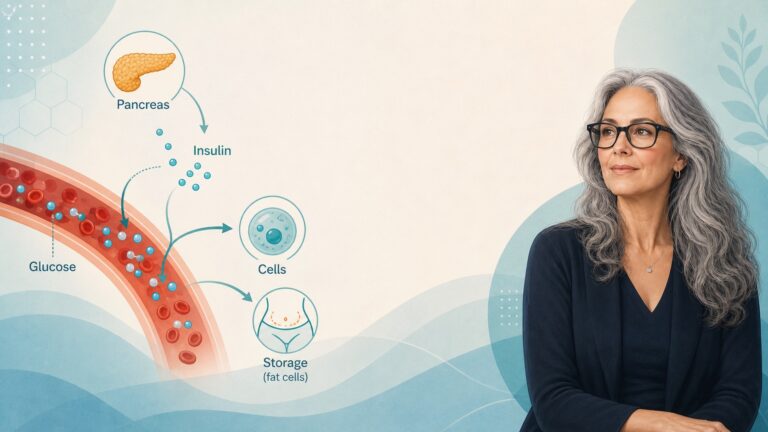

Can you get pregnant during perimenopause? Yes, you can — and that is exactly why this stage of life can catch women off guard. Periods may become irregular, ovulation may happen less often, and fertility does decline, but it does not drop to zero until menopause is reached. That means it is still possible to conceive naturally during perimenopause, even if your cycle has become unpredictable and even if you feel “too old” for pregnancy.
This matters because the signs of perimenopause and the signs of pregnancy can overlap in surprisingly confusing ways. A missed period, fatigue, sore breasts, mood swings and poor sleep can belong to either one. Many women assume that changing hormones mean pregnancy is no longer possible, but until you have gone 12 months without a period, pregnancy can still happen.
If you are not quite sure where perimenopause ends and menopause begins, our complete menopause guide for women over 45 explains the full timeline, common symptoms and treatment options in more detail.
This article explains how perimenopause works, why pregnancy is still possible, which symptoms can be confused, what the risks are, and how to look after yourself during this transition. It is not here to frighten you. It is here to help you stay informed, protect your health and make confident choices.
Can you get pregnant during perimenopause? And what is it, exactly?
Perimenopause is the transition leading up to menopause, when hormone levels begin to shift and menstrual cycles often become less predictable. During this time, oestrogen and progesterone do not decline in a neat, steady line; they fluctuate. Ovulation becomes more erratic, but it can still occur, which is why pregnancy remains possible.
Menopause itself is only confirmed once you have gone 12 consecutive months without a period. Before that point, even if your periods are all over the place or seem to have disappeared for several months, you are still considered potentially fertile.
This is one of the biggest misunderstandings around midlife fertility. Many women think irregular periods mean their reproductive years are over.
In reality, perimenopause is a time of declining fertility, not zero fertility.
So, can you get pregnant during perimenopause?
Yes. If you are still ovulating, even only occasionally, you can still get pregnant. Ovulation may be sporadic, but it does not need to happen every month for conception to be possible.
Some guidance aimed at clinicians notes that ovulation can still occur in many cycles in the years leading up to menopause, which is why contraception is still important if pregnancy is not wanted. Research also shows that although the absolute chance of pregnancy falls during perimenopause, unintended pregnancy still occurs and should not be dismissed.
This is why “I haven’t had a proper period in ages” is not a reliable form of contraception. Neither is “I’m in my forties now, so it probably can’t happen.” If pregnancy would be a shock, it makes sense to stay careful until menopause is confirmed.
Why women get caught out in perimenopause
Perimenopause is full of mixed signals. One month you may have a heavy period. The next month you may skip one entirely. Then your cycle returns again. That uncertainty can create a false sense of security.
Many women also stop thinking of themselves as fertile because the cultural conversation around pregnancy is so focused on younger women.
But biology does not switch off neatly on your 40th birthday. Fertility drops, yes, but as long as an egg is released and sperm meets it, pregnancy is still possible.
There is also the symptom confusion factor. If you are suddenly exhausted, emotional, nauseous or dealing with breast tenderness, it can be tempting to blame hormones and move on. Sometimes that is exactly what it is. But sometimes it is early pregnancy.
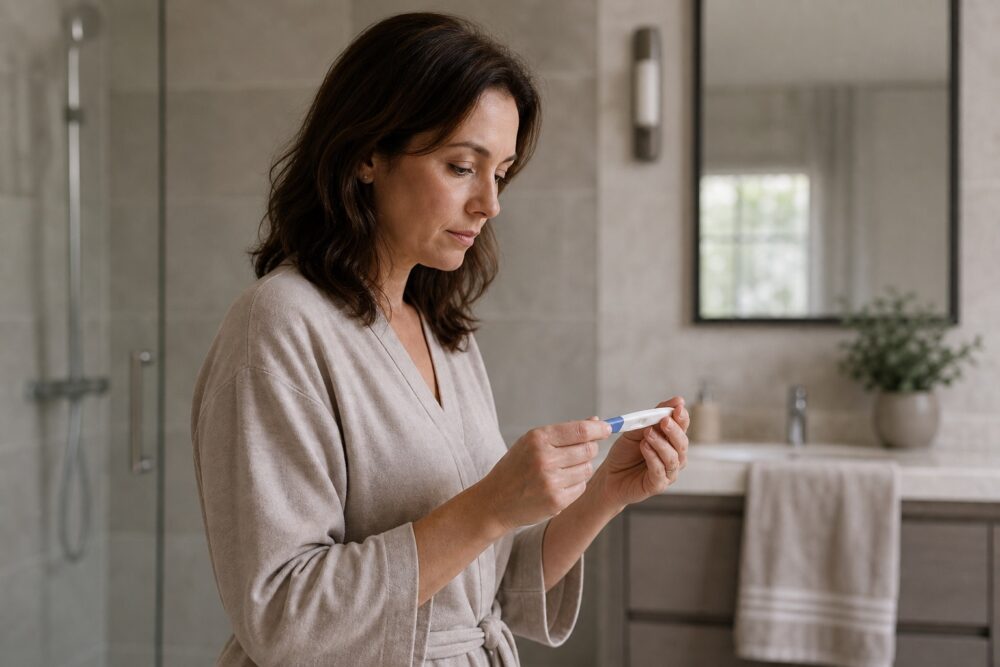
Perimenopause symptoms that can look like pregnancy
This is where things get tricky. Perimenopause and pregnancy can look surprisingly similar, especially in the early weeks.
Symptoms that may overlap include:
- Missed or irregular periods.
- Breast tenderness or fullness.
- Fatigue and low energy.
- Sleep disturbances.
- Mood changes, tearfulness or irritability.
- Headaches.
- Changes in libido.
- Nausea or a general feeling of being “off”, which some women notice in both hormonal transition and early pregnancy.
Because of this overlap, it is not wise to self-diagnose purely based on symptoms.
If there is any chance of pregnancy, taking a home pregnancy test is the simplest first step. If the result is unclear, repeat it according to the instructions or speak to your GP or pharmacist.
Pregnancy signs that may be mistaken for perimenopause
The confusion works both ways. A woman in her forties may assume that a missed period, breast soreness or emotional ups and downs must be perimenopause, when in fact they are pregnancy symptoms.
This matters because the earlier a pregnancy is recognised, the sooner you can start the right care. Early pregnancy support matters at any age, but especially in midlife, when there may be extra health considerations, medication questions or a need for prompt discussion with a doctor or midwife.
If you are sexually active and your periods have changed, it helps to keep pregnancy in the back of your mind as one possible explanation until it has been ruled out.
What are the risks of pregnancy during perimenopause?
Pregnancy in the forties is not impossible, and many women do go on to have healthy pregnancies and healthy babies. But it is also true that pregnancy risks rise with age, and women deserve clear information about that.
Important risks include:
- Miscarriage: the risk rises significantly with maternal age. RCOG-linked information and NHS sources note that miscarriage risk increases over 40, and one NHS resource states that more than 5 in 10 pregnancies in women over 45 end in miscarriage. A hospital guide for women having a baby after 40 also states that around 1 in 2 pregnancies in women over 45 end in miscarriage.
- Chromosomal abnormalities: the risk of chromosomal conditions, including Down’s syndrome, rises with maternal age.
- Ectopic pregnancy: guidance for women over 40 notes an increased risk of ectopic pregnancy.
- Preterm birth and stillbirth: older maternal age is associated with higher risks, including an increased risk of stillbirth as pregnancy continues beyond term.
- Pregnancy complications: advanced maternal age is linked to higher rates of conditions such as gestational diabetes, hypertensive disorders and postpartum haemorrhage.
This does not mean every pregnancy in perimenopause is doomed or dangerous.
It means the margin for “I’ll just wait and see” is smaller. Prompt medical care, good antenatal follow-up and attention to your overall health matter even more.
If you do not want to get pregnant, be careful with contraception
This is one of the most important messages in the whole article: if you are in perimenopause and do not want to conceive, you still need contraception.
The old myth that contraception is unnecessary once your periods become irregular is simply not true. Reliable contraception should continue until menopause is confirmed.
General guidance says:
- If you are under 50, contraception is usually needed for 2 years after your last natural period.
- If you are 50 or over, contraception is usually needed for 1 year after your last natural period.
- Natural pregnancy after 55 is very rare, and NHS guidance says contraception is no longer needed after age 55.
It is also worth remembering that hormone replacement therapy is not contraception. HRT can help symptoms, but it does not prevent pregnancy. If you need both symptom relief and pregnancy prevention, speak to a clinician about how to combine the right approach safely.
Can fertility awareness methods be trusted during perimenopause?
This is another area where caution matters. Fertility awareness methods can become much less reliable in perimenopause because ovulation and cycle length are unpredictable. When your body is sending mixed signals, calendar-based guessing is not a dependable way to avoid pregnancy.
If avoiding pregnancy is important to you, a more reliable contraceptive method is usually the safer choice.
What if you have had unprotected sex?
If you have had unprotected sex or your contraception has failed during perimenopause, do not assume your age will protect you. Emergency contraception may still be appropriate, depending on timing and the method used.
Contact a pharmacist, GP, sexual health clinic or urgent care service as soon as possible. Time matters with emergency contraception.
Looking after yourself during perimenopause, whether pregnancy is wanted or not
Perimenopause is a stage where self-care needs to become more intentional. Hormonal changes, sleep disruption and heavier or irregular bleeding can all leave you feeling depleted. If there is also a possibility of pregnancy, it makes even more sense to pay attention to your body rather than brushing symptoms aside.
Here are sensible ways to look after yourself:
1. Keep track of your cycle and symptoms
Even if your periods are erratic, it helps to note bleeding, missed periods, mood changes, breast symptoms, sleep patterns and any unusual nausea or pelvic pain. A simple tracking app or paper diary can make patterns easier to see and can also be useful if you need to speak to your GP.
2. Take symptoms seriously
Do not assume everything is “just hormones”. If you have missed periods and are sexually active, do a pregnancy test.
3. Review your contraception
If you do not want a pregnancy, make sure your contraception is still appropriate for this stage of life. Midlife is a good time to review whether your method still suits your body and health profile.
4. Check medicines and supplements
If pregnancy is possible, it is wise to be mindful of anything you are taking, including over-the-counter remedies and supplements. If you are trying to avoid pregnancy, this still matters because an unplanned pregnancy can happen before you have had time to review medications with a clinician.
5. Support your general health
The basics still count: regular meals, enough protein, movement, sleep support where possible, stress management, and keeping up with routine health checks. Perimenopause can be physically and emotionally draining, and caring for yourself is not vanity. It is preparation.
6. Get medical advice early
If you think you may be pregnant, do not sit with uncertainty for too long. If you think you are in perimenopause but the pattern is unusual, ask for help. And if you are unsure whether your symptoms are hormonal, gynaecological or pregnancy-related, you do not need to solve the puzzle alone.
What to do if pregnancy is possible
If you think there is any chance you could be pregnant:
- Take a home pregnancy test.
- Repeat it if needed according to the instructions.
- Contact your GP, pharmacist, sexual health clinic or maternity service if it is positive or if symptoms are confusing.
- Seek urgent help if you have severe pain, shoulder tip pain, dizziness, fainting or heavy bleeding, because these can be warning signs of ectopic pregnancy or miscarriage.
The aim is not to panic. It is simply to act early.
The emotional side of pregnancy risk in perimenopause
This topic can stir up a lot of feelings. For some women, the possibility of pregnancy in perimenopause is frightening. For others, it may bring grief, hope, ambivalence or confusion. Sometimes it touches bigger questions about ageing, fertility, sexuality and identity.
That emotional complexity deserves respect. There is no single “right” way to feel. What matters is giving yourself accurate information and support, so that you are not making decisions from myths or assumptions.
The bottom line
Can you get pregnant during perimenopause? Yes, you can. Fertility is lower, but it is not zero until menopause is confirmed. Because perimenopause and pregnancy can look so similar, it is easy to miss the signs, and because pregnancy risks rise with age, it is wise to take the possibility seriously.
If pregnancy is not wanted, keep using reliable contraception until you are safely past the point where it is needed.
References
- Cleveland Clinic – Perimenopause and your fertility
- Contraceptive Technology – Perimenopause and pregnancy risks
- National Library of Medicine – Contraception during the perimenopause
- Aapec – Contraception during the menopause
Disclaimer – This article is for general information only and does not replace individual medical advice. It cannot assess your personal risk, diagnose a condition or recommend specific treatment. Always speak to your GP, gynaecologist or another qualified health professional about your own symptoms, medications, contraception and pregnancy plans, especially if you are over 35, in perimenopause or think you might be pregnant.